📖 Day 21: Lessons from a Reluctant Prophet
Scripture:
“Should I not be concerned about that great city?” — Jonah 4:11
🌿 Reflection
Jonah’s story ends not with Jonah’s words,
but with God’s.
The book closes on a question —
an unfinished sentence
left open on purpose
because it invites us to answer.
Jonah was imperfect.
He ran.
He resisted.
He argued.
He wrestled with God’s mercy.
And yet…
God pursued him.
God protected him.
God provided for him.
God patiently shaped him.
God used him — even reluctantly — to bring an entire city to repentance.
Jonah’s story teaches us:
• God’s calling is bigger than our fear.
• God’s mercy reaches further than our comfort.
• God’s heart breaks for the lost — even when ours doesn’t yet.
• God works in us while He works through us.
• Grace transforms both the runner and the city.
Jonah wanted justice.
God wanted redemption.
And God still asks His children today:
“Will you share My heart for people?”
Not just those who are easy to love,
but the ones who feel unworthy,
unlikely,
unknown,
or even undeserving.
Jonah’s story isn’t a story of failure —
it’s a story of formation.
A testimony that God never gives up on us,
even when we’re complicated, stubborn, or scared.
This final day is an invitation:
Let your heart stretch toward compassion.
Let God’s mercy flow through you.
Let your life reflect the patience, tenderness, and love God showed Jonah — and Nineveh — and you.
📝 Journal Prompt
What is the greatest lesson God has shown you through the book of Jonah?
Where is He inviting you to grow in compassion, obedience, or trust?
Write your closing thoughts, your gratitude, and your next step.
📖 Day 20: God’s Heart Revealed
Scripture:
“But the Lord said, ‘You have been concerned about this plant, though you did not tend it or make it grow… And should I not have concern for the great city of Nineveh?’” — Jonah 4:10–11
🌿 Reflection
God’s final words in the book of Jonah are not about Jonah.
They are about His heart.
Jonah grieves a plant —
a temporary comfort, a moment of shade, a symbol of his own needs.
But God grieves a city.
A city full of people who didn’t know right from wrong.
A city full of souls He created.
A city He longed to rescue, not destroy.
“Should I not be concerned?”
This is the question that echoes through the book.
Not a rebuke —
but an invitation.
God invites Jonah to see what He sees.
To care how He cares.
To expand the small borders of his heart so they can stretch toward compassion.
Where Jonah saw enemies,
God saw children.
Where Jonah saw wickedness,
God saw lostness.
Where Jonah wanted justice,
God longed for restoration.
This is the heart of God on full display:
A God who runs toward the rebellious,
forgives the repentant,
comforts the broken,
and patiently reshapes the stubborn.
Jonah’s story ends with a question —
because God wants the answer to be lived, not spoken.
And that question comes to us too:
Will you share God’s heart for others?
Even the difficult ones?
The undeserving ones?
The ones you don't understand?
The ones who hurt you?
This is the invitation to mercy, compassion, and a heart transformed.
📝 Journal Prompt
Who is God inviting you to see with new compassion?
Where is He stretching your heart beyond your comfort?
Write about someone, some place, or some situation where God may be asking you:
“Should I not be concerned?”
📖 Day 19: God’s Question of Compassion
Scripture:
“But God said to Jonah, ‘Is it right for you to be angry about the plant?’” — Jonah 4:9
🌿 Reflection
God doesn’t shout.
He doesn’t scold.
He doesn’t shame.
He simply asks a question.
A question meant not to trap Jonah,
but to heal him.
Jonah is furious — about the plant, the heat, the wind, the mercy shown to Nineveh, the discomfort within his own heart.
But God gently brings Jonah to a place of self-examination:
“Is it right?”
Is your anger justified?
Is this the whole truth?
Is this where you want to stay?
When God asks a question, it is never because He lacks information.
It is because we lack clarity.
This question is not about the plant at all.
It is about Jonah’s compassion — or lack of it.
About the tight places in Jonah’s heart that cannot rejoice when others receive mercy.
God is doing heart surgery with a single sentence.
He invites Jonah to look inward, to see what’s driving his anger, to notice what matters more to him — comfort or compassion.
And He invites us to ask the same:
Where does my anger speak louder than my mercy?
What do I defend more fiercely than God’s heart for others?
Sometimes the most transformative moment in our walk with God begins with a quiet, honest question.
📝 Journal Prompt
What emotions in your life feel “justified,” but may be hiding deeper hurt, fear, or pride?
Write about a place where God may be asking you gently:
“Is it right for you to feel this way?”
Let His question unfold something tender.
📖 Day 18: The Scorching Wind
Scripture:
“When the sun rose, God provided a scorching east wind, and the sun blazed on Jonah’s head so that he grew faint. He wanted to die, and said, ‘It would be better for me to die than to live.’” — Jonah 4:8
🌿 Reflection
This is Jonah’s lowest moment.
The plant is gone.
The sun is burning.
A harsh wind beats against him.
His anger and exhaustion crash into despair.
And Jonah cries out — not with rebellion this time, but with deep discouragement.
This moment reveals something tender:
Jonah isn’t just angry…
He’s hurting.
God isn’t punishing Jonah with the wind and the heat.
He is uncovering the raw places of Jonah’s soul —
the places where bitterness, disappointment, and unhealed hurt have been hiding.
Sometimes God allows us to feel the heat
not to destroy us,
but to bring our buried pain to the surface
so He can speak into it.
The scorching wind shows Jonah his limits.
And it is often in our faintness that we finally let God address what’s beneath the surface.
This is not a moment of God’s cruelty.
It is a moment of God’s compassion —
preparing Jonah for the gentle, transforming question that will follow.
📝 Journal Prompt
Where have you felt “the heat” recently — emotionally, spiritually, or circumstantially?
Write about how God may be using this moment not to harm you, but to reach a place in your heart that needs healing.
📖 Day 17: When God Removes the Comfort
Scripture:
“But at dawn the next day God provided a worm, which chewed the plant so that it withered.” — Jonah 4:7
🌿 Reflection
Yesterday, Jonah was comforted.
Today, the comfort disappears.
The plant dies, and Jonah is exposed to the heat again.
It feels sharp, sudden, and unfair — especially to Jonah, who was already angry and exhausted.
But here is the important truth:
The God who gives the plant is the same God who takes it away —
not to harm Jonah, but to heal him.
God isn’t being cruel.
He is revealing Jonah’s heart.
Sometimes God uses the removal of comfort
to uncover what’s been buried beneath it:
• our attachments
• our entitlements
• our expectations
• our assumptions about what God should do
Jonah loved the plant more than the people.
He cherished the comfort more than the compassion God wanted to grow in him.
The worm exposes that truth.
Not to shame Jonah — but to help him see.
This moment invites us to reflect gently:
What do I cling to more than God’s heart for others?
Because sometimes the loss of a temporary comfort
is the beginning of a deeper transformation.
📝 Journal Prompt
Has God ever removed a comfort from your life — not to hurt you, but to reveal something or guide you?
Write about a moment when a loss became a window into your heart.
📖 Day 16: The Shelter and the Lesson
Scripture:
“Then the Lord God provided a leafy plant and made it grow up over Jonah to give shade for his head to ease his discomfort, and Jonah was very happy about the plant.” — Jonah 4:6
🌿 Reflection
Jonah is still sitting outside the city, waiting to see what God will do.
He’s angry.
He’s exhausted.
He’s emotionally worn thin.
And God — in kindness — provides shade.
Jonah hasn’t softened yet.
He hasn’t surrendered his anger.
He hasn’t repented or rejoiced.
But God still cares for him.
He gives Jonah comfort, even in his stubbornness.
What a picture of divine tenderness.
This plant becomes a living parable — a moment of unexpected grace designed to reach past Jonah’s anger and touch his heart.
Jonah is “very happy” about the plant — the first time we see Jonah happy about anything in this book — because compassion feels good when it benefits us.
But God’s about to show him what compassion looks like when it’s extended to others.
Before the lesson comes, Jonah experiences God’s comfort.
And maybe that’s true for us, too — before God confronts our hearts, He often comforts them.
📝 Journal Prompt
Where has God given you unexpected comfort during a difficult or stubborn season?
Write about a time when God cared for you even when your heart wasn’t in the right place.
📖 Day 15: When Mercy Feels Unfair
Scripture:
“But to Jonah this seemed very wrong, and he became angry.” — Jonah 4:1
🌿 Reflection
Jonah finally obeyed.
Nineveh repented.
God showed mercy.
And Jonah… got angry.
It feels jarring until we’re honest with ourselves —
because we’ve all felt this way at times.
Jonah wasn’t furious about the message.
He was furious about the mercy.
He wanted justice.
He wanted consequences.
He wanted God to treat Nineveh as Jonah felt they deserved.
But God’s heart is not driven by Jonah’s wounds.
It is driven by compassion.
Jonah’s anger exposes something tender inside him:
a place of pain he hasn’t surrendered,
a wound that distorts how he sees others,
a fear that mercy might mean injustice.
But God invites Jonah — and us — into a deeper truth:
His mercy is bigger than our sense of fairness.
And sometimes the hardest work God does in us
is not through storms or whales or second chances —
but through confronting our resistance to His grace for others.
This moment is not God scolding Jonah.
It is God gently uncovering Jonah’s heart.
📝 Journal Prompt
Is there someone you struggle to forgive?
Someone you feel doesn’t deserve mercy?
Write honestly about an area where God may be inviting you
to release anger, loosen control, or soften your heart.
📖 Day 14: God Relents
Scripture:
“When God saw what they did and how they turned from their evil ways, He relented and did not bring on them the destruction He had threatened.” — Jonah 3:10
🌿 Reflection
Nineveh didn’t just listen — they changed.
Their repentance was real, deep, and immediate.
And God responded in the way only God does:
with mercy stronger than judgment.
This verse is one of the most beautiful in the book of Jonah.
It reveals God’s heart — not eager to punish, slow to anger, rich in compassion, always ready to withhold judgment when a heart turns toward Him.
God relented.
He changed course.
He chose mercy over wrath.
Not because Nineveh deserved it,
but because that’s who He is.
The entire story of Jonah reminds us that God’s justice is real —
but His compassion is greater.
He is moved by humility.
He responds to repentance.
He bends toward grace.
And maybe this verse speaks to us personally too…
There are places we fear God might give up on us.
Places we brace for consequences we think we’ve earned.
But God looks for the smallest turn of the heart —
and meets it with tenderness.
He relents.
He restores.
He renews.
📝 Journal Prompt
Where have you been afraid of God’s judgment, only to find mercy instead?
Write about an area where you hope for God to “relent” —
to show compassion, to ease the weight, or to bring unexpected grace.
📖 Day 13: The King’s Response
Scripture:
“When Jonah’s warning reached the king of Nineveh, he rose from his throne, took off his royal robes, covered himself with sackcloth and sat down in the dust.” — Jonah 3:6
🌿 Reflection
When Jonah’s message reached the very heart of Nineveh — the king himself — something extraordinary happened. The most powerful man in the city stepped down from his throne. He traded robes for sackcloth. Comfort for humility. Pride for repentance.
True change often begins in the quiet act of stepping down.
The king didn’t defend himself.
He didn’t justify the past.
He didn’t hide behind rank or reputation.
He simply humbled himself before God.
It’s a reminder to us:
Repentance is not about status — it is about surrender.
Even the most elevated places in our lives, the ones we try to protect or prove, must be laid down before God.
Sometimes the throne we need to step down from isn’t a literal one…
It’s control.
It’s self-sufficiency.
It’s the image we hold onto.
It’s the fear of being seen as weak.
But in Scripture, humility is never weakness — it is openness.
It is the door through which grace rushes in.
📝 Journal Prompt
Where is God inviting you to “step down”?
Is there an area where humility could open the door to healing, clarity, or deeper obedience?
Write about the throne you may be holding onto — and what it might look like to gently lay it down before God.
📖 Day 12: From the Greatest to the Least
Scripture:
“The Ninevites believed God. A fast was proclaimed, and all of them, from the greatest to the least, put on sackcloth.” — Jonah 3:5
🌿 Reflection
Jonah expected resistance.
He expected hard hearts.
He expected rejection.
Instead… they believed.
Immediately.
Deeply.
Collectively.
From leaders to laborers, from the wealthy to the forgotten, an entire city responds with humility. This wasn’t shallow emotion—it was true repentance. One simple message reached deep into the soul of a nation, and something ancient and holy awakened.
This verse shows us that no one is beyond the reach of God’s voice.
Sometimes the people we assume are farthest from God are actually the most ready to hear Him.
All God needed was a reluctant prophet willing to walk across a city…
and an entire people turned their faces toward Him.
It reminds us that revival doesn’t begin with crowds—
it begins with hearts willing to say,
"God, we hear You.”
📝 Journal Prompt
Where have you underestimated what God can do—in yourself, in someone you love, or in a place you thought was too far gone?
Write about a situation where you now sense God may already be at work behind the scenes.
📖 Day 11: A Simple Message, A Stirred City
Scripture:
“Jonah began by going a day’s journey into the city, proclaiming, ‘Forty more days and Nineveh will be overthrown.’” — Jonah 3:4
🌿 Reflection
Jonah steps into Nineveh and speaks one short sentence.
No poetry.
No long sermon.
No impressive performance.
Just eight Hebrew words.
Yet those eight words shake an entire city.
This is how God works—
He takes simple obedience and fills it with power.
Jonah didn’t feel holy, polished, or perfect.
He had no eloquence, no confidence, no charm.
But he had one thing: a yes.
A yes to walk.
A yes to speak.
A yes to obey the second time.
And God did the rest.
This verse reminds us that God’s power is never in our perfection—
it’s in His presence.
He can move through the smallest offering, the briefest word, the faintest step forward.
You never know what God is doing beneath the surface when you simply show up.
📝 Journal Prompt
Where is God asking you to offer something simple—
a word, a step, a prayer, a small act of obedience?
Write about the “small thing” God may be preparing to use in a big way.
📖 Day 10: The Message of Mercy
📖 Day 10: The Message of Mercy
Scripture:
“Jonah obeyed the word of the Lord and went to Nineveh.” — Jonah 3:3
🌿 Reflection
Jonah finally goes.
Not as the same man who ran.
Not as the one swallowed by guilt.
But as someone shaped by grace.
God didn’t just rescue Jonah—He transformed him.
The man who once fled from God’s call now steps into it. The road to Nineveh is long, dry, and uncomfortable, but Jonah walks it because he knows what mercy feels like in the depths. And those who have tasted mercy become the best messengers of it.
God doesn’t need perfect people to carry His message—He uses the willing. Jonah goes to Nineveh not because he feels qualified, but because God called again… and this time Jonah said yes.
And so God sends a deeply flawed, freshly restored prophet to deliver a message that will change a city.
Grace doesn’t just save us—it sends us.
📝 Journal Prompt
Where is God sending you now?
What step of obedience—big or small—is He inviting you to take today?
Write about the places, people, or purposes He may be preparing your heart to walk toward.
📖 Day 9: The Second Time
📖 Day 9: The Second Time
Scripture:
“Then the word of the Lord came to Jonah a second time.” — Jonah 3:1
🌿 Reflection
God speaks to Jonah again.
Not with frustration.
Not with reminders of his failure.
Not with a list of what Jonah should have done differently.
Just… a second chance.
After running, after the storm, after the belly of the fish, after regret and repentance—God still calls Jonah. The call didn’t disappear because Jonah stumbled. The purpose didn’t vanish because he ran. Grace doesn’t cancel the mission; it restores the messenger.
We often think our mistakes disqualify us.
But God thinks differently.
He meets us where we are, lifts us up, and speaks again.
Jonah’s story reminds us:
You cannot outrun God’s mercy.
You cannot fall beyond His reach.
And when He speaks “a second time,” it is never with condemnation—only invitation.
📝 Journal Prompt
Where has God given you a “second time”?
Is there something He’s calling you back to—something you thought you ruined, lost, or disqualified yourself from?
Write about how His mercy is rewriting your story.
📖 Day 8: The Deliverance
📖 Day 8: The Deliverance
Scripture:
“And the Lord commanded the fish, and it vomited Jonah onto dry land.” — Jonah 2:10
🌊 Reflection
Just when Jonah thought the darkness would be his end, God spoke.
Not in anger.
Not in harshness.
But in mercy.
The same God who sent the fish now commands it to release him. Deliverance comes—not because Jonah was perfect, but because God is compassionate. The belly had been a place of pause, a place of prayer, a place of undoing and remaking. Now Jonah is placed gently back on solid ground, with purpose beneath his feet again.
Sometimes God’s rescue doesn’t look polished or pretty. Sometimes we stumble onto the “shore” still dripping with the evidence of where we’ve been. But grace doesn’t wait for us to be cleaned up—it meets us as we are and leads us forward.
God doesn’t just free Jonah from the fish…
He frees him from the shame that swallowed him.
He frees him to begin again.
And He does the same for us.
📝 Journal Prompt
Where have you seen God bring you out of something dark and into a fresh beginning?
What “dry land” has He placed in front of you that you can step onto with gratitude today?
📖 Day 7: The Prayer
📖 Day 7: The Prayer
Scripture: “When my life was ebbing away, I remembered You, Lord, and my prayer rose to You, to Your holy temple.” — Jonah 2:7
🌊 Reflection
In the belly of the fish, Jonah remembers God. At rock bottom, stripped of distractions, he prays with desperation and clarity. It’s in the dark that Jonah finally looks up. This moment reminds us that no place is too far, no pit too deep, no heart too distant for prayer to reach heaven.
📝 Journal Prompt
What do your most honest prayers sound like?
Write out a prayer from a place of vulnerability. What are you holding back from God that you need to surrender?
🌊 Day 6: In the Belly of the Fish 🐳
🌊 Day 6: In the Belly of the Fish 🐳
Scripture:
"From inside the fish Jonah prayed to the Lord his God." — Jonah 2:1
Reflection:
Sometimes the belly of the fish is exactly where transformation begins. Jonah, swallowed and still, cried out—not from a temple or mountain top, but from a dark, hidden place. Our lowest places can become our holiest altars when we turn to God in surrender. Prayer from the pit still reaches heaven. 🌌
✨ Journal Prompt:"When have you found yourself in a dark or isolating place—physically, emotionally, or spiritually—where all you could do was cry out to God? What did you learn about His presence in that space?"
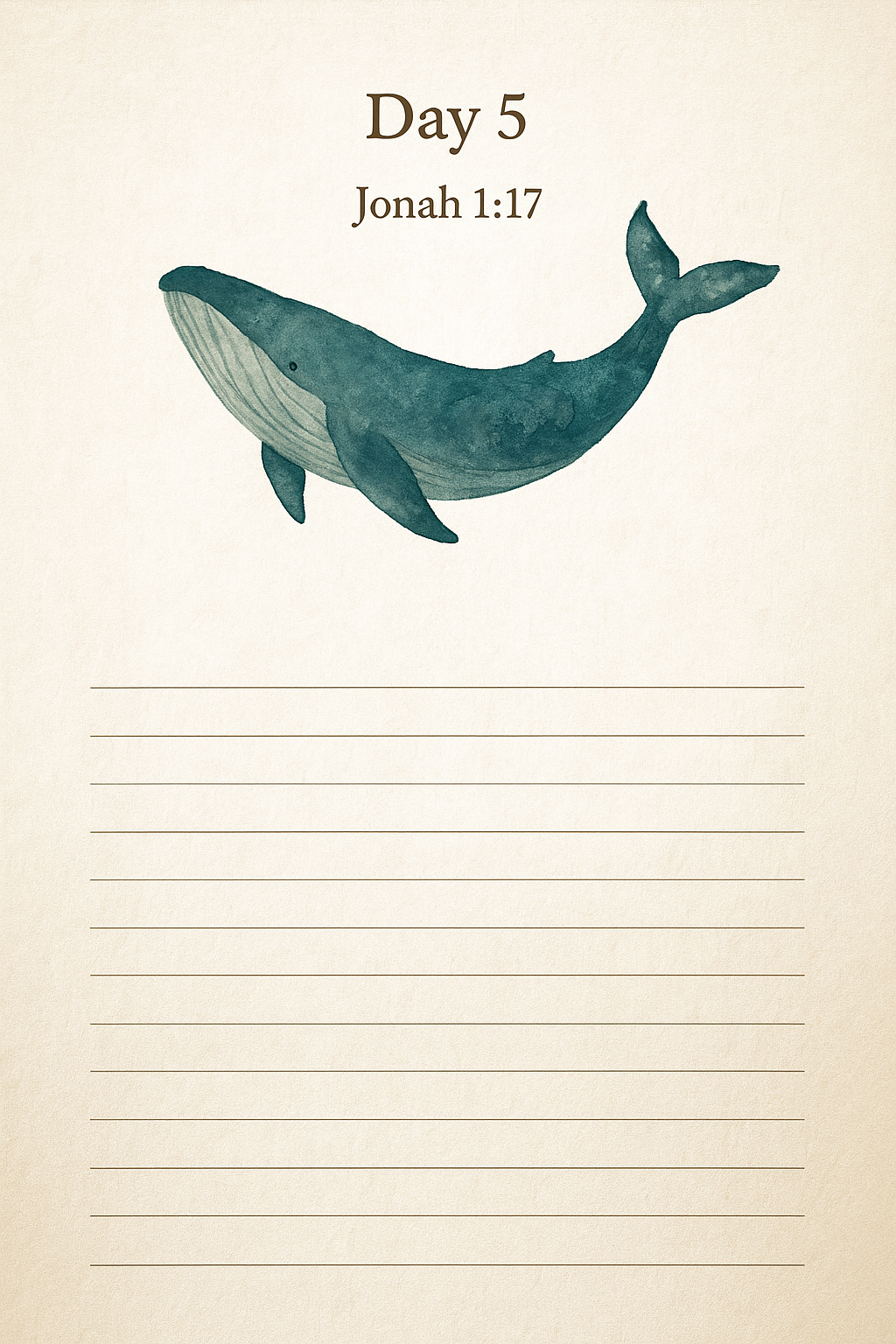
🐋 Day 5: Swallowed by Mercy
🐋 Day 5: Swallowed by Mercy
Scripture:
“Now the Lord provided a huge fish to swallow Jonah…” — Jonah 1:17
Reflection:
When Jonah hit rock bottom, God didn’t abandon him—He provided a way. Not a way out, but a way through. 🐳 Sometimes mercy doesn’t look like immediate rescue; sometimes it looks like a pause in the belly of the storm so we can come back to our senses and back to God. The fish wasn’t punishment—it was provision.
Are you in a place that feels dark and confining? You may be in a holding place for healing, not punishment. Trust the One who sent the fish.
📝 Prompt:
Write about a time when mercy didn’t look the way you expected. How did God meet you in that place?
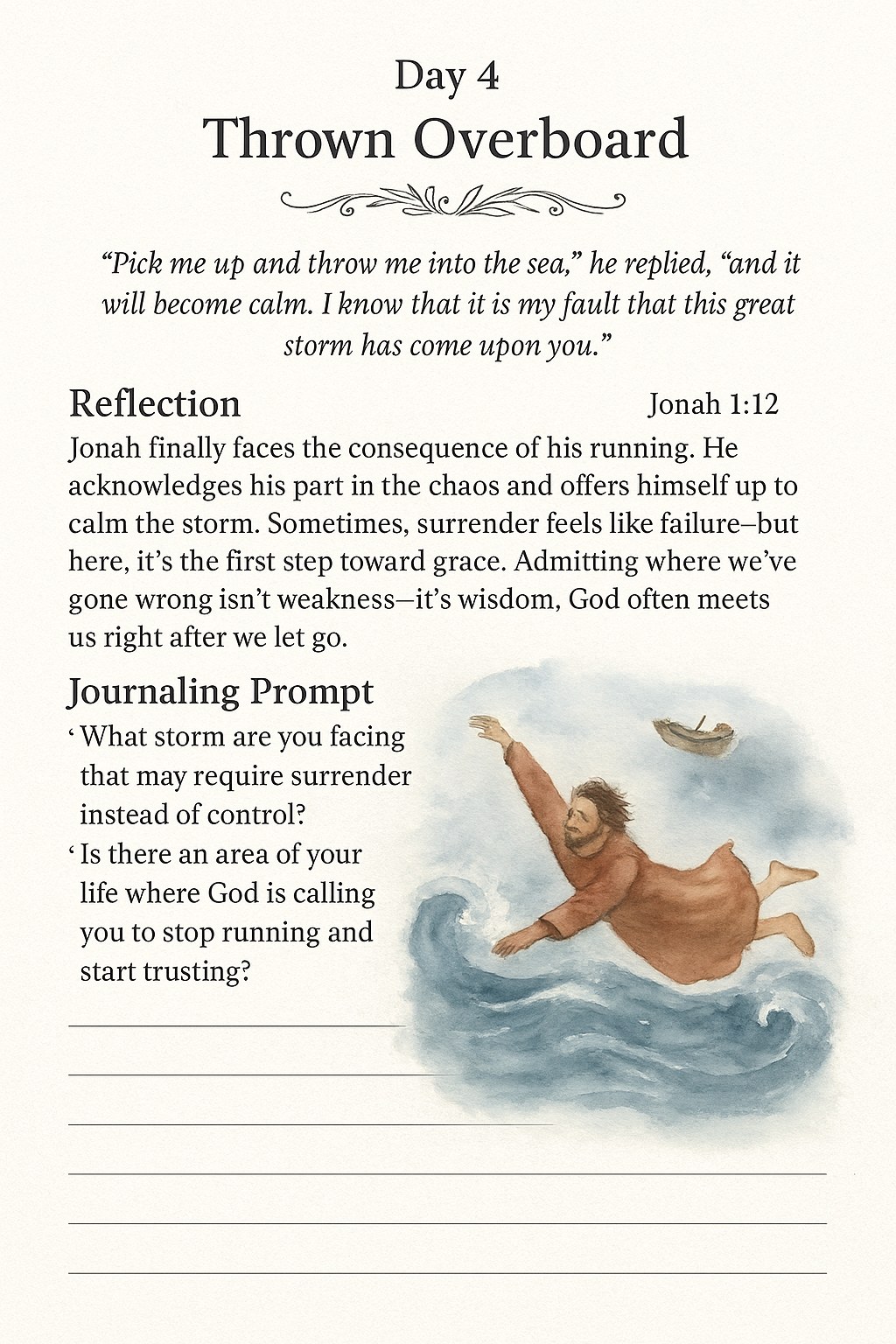
Day 4: Thrown Overboard
Scripture:
"Pick me up and throw me into the sea,” he replied, “and it will become calm. I know that it is my fault that this great storm has come upon you.”
— Jonah 1:12
Reflection:
Jonah finally faces the consequence of his running. He acknowledges his part in the chaos and offers himself up to calm the storm. Sometimes, surrender feels like failure—but here, it’s the first step toward grace. Admitting where we’ve gone wrong isn’t weakness—it’s wisdom. God often meets us right after we let go.
Journaling Prompt:
What storm are you facing that may require surrender instead of control?
Is there an area of your life where God is calling you to stop running and start trusting?
📖 Day 3: The Storm
📖 Day 3: The Storm
Scripture:
“Then the Lord sent a great wind on the sea...” — Jonah 1:4
🌊 Reflection Prompt:
Storms aren’t always signs of punishment—they can be divine interventions. Jonah’s storm wasn’t random. It was God’s fierce mercy calling him back.
Have you ever felt stopped in your tracks by a storm? Could it be God’s mercy, not His wrath?
Use this space to reflect on how God might be redirecting you through the storms in your own life.
Day 2 – The Storm Reveals the Heart
Day 2 – The Storm Reveals the Heart
Scripture: Jonah 1:4–6
“Then the Lord sent a great wind on the sea, and such a violent storm arose that the ship threatened to break up.” (v. 4)
Devotional Reflection:
God doesn't always stop us from running, but He does meet us in the storm. When Jonah fled from God's call, it wasn't smooth sailing. A fierce storm crashed into his plans—not as punishment, but as a redirection. Sometimes the chaos around us is a divine invitation to pause and reconsider.
Notice how Jonah sleeps through the storm while everyone else scrambles to survive. Like Jonah, we can be numb to the wake-up calls in our lives. Yet God is merciful—even the storm is His mercy, sent not to destroy but to awaken.
What are the storms in your life revealing? Are they disruptions—or invitations to return to the One who calms both seas and souls?
Prompt for Reflection:
What storms have caught your attention lately?
Is there something God might be saying through them?
How do you usually respond when your plans get interrupted?